Europa-Park operates multiple dark rides across its themed areas. Two of the park's long-standing indoor attractions — Geisterschloss in the Italian zone and Piccolo Mondo in the same area — offer a study in how different transport systems produce different boarding experiences. This walkthrough examines each ride's approach to guest flow, vehicle boarding, and theming density, noting the structural differences between the two systems without evaluating them against each other.
Contents
Key Context
- Geisterschloss (Ghost Castle) is a dark ride in Europa-Park's Italian themed area that uses a continuous chain transport system — vehicles move without stopping, requiring guests to board from a moving platform or slow-moving belt.
- Piccolo Mondo is a dark ride in the same area using a conventional vehicle system where trains stop at a platform for guests to board and disembark.
- Both attractions have operated at Europa-Park for several decades and represent different generations of dark ride engineering that are still in active operation at European parks.
- Geisterschloss opened in 1982 and uses a system manufactured by Heimo. Piccolo Mondo is a boat-type dark ride.
- Both rides are accessible to guests who cannot manage standard roller coaster restraint systems, making the boarding process design particularly relevant to park accessibility.
The endless chain system: Geisterschloss
Omnimover-style continuous chain systems — where vehicles move in an unbroken loop and never fully stop — present a fundamentally different boarding challenge than conventional stop-and-go systems. For Geisterschloss, guests approach a moving walkway or slow conveyor that brings them alongside the moving vehicles. They step into the vehicle while it is in motion at a very low speed.
The mechanism allows for very high throughput because loading does not require the train to stop. Each vehicle can be loaded as the chain continues, unlike a batch-loading system where the train stops, loads, and then dispatches, requiring all vehicles to pause simultaneously. The trade-off is that guests who are slower to board — due to mobility considerations, young children, or unfamiliarity with the system — are under time pressure in a way that stop-and-go systems do not create.
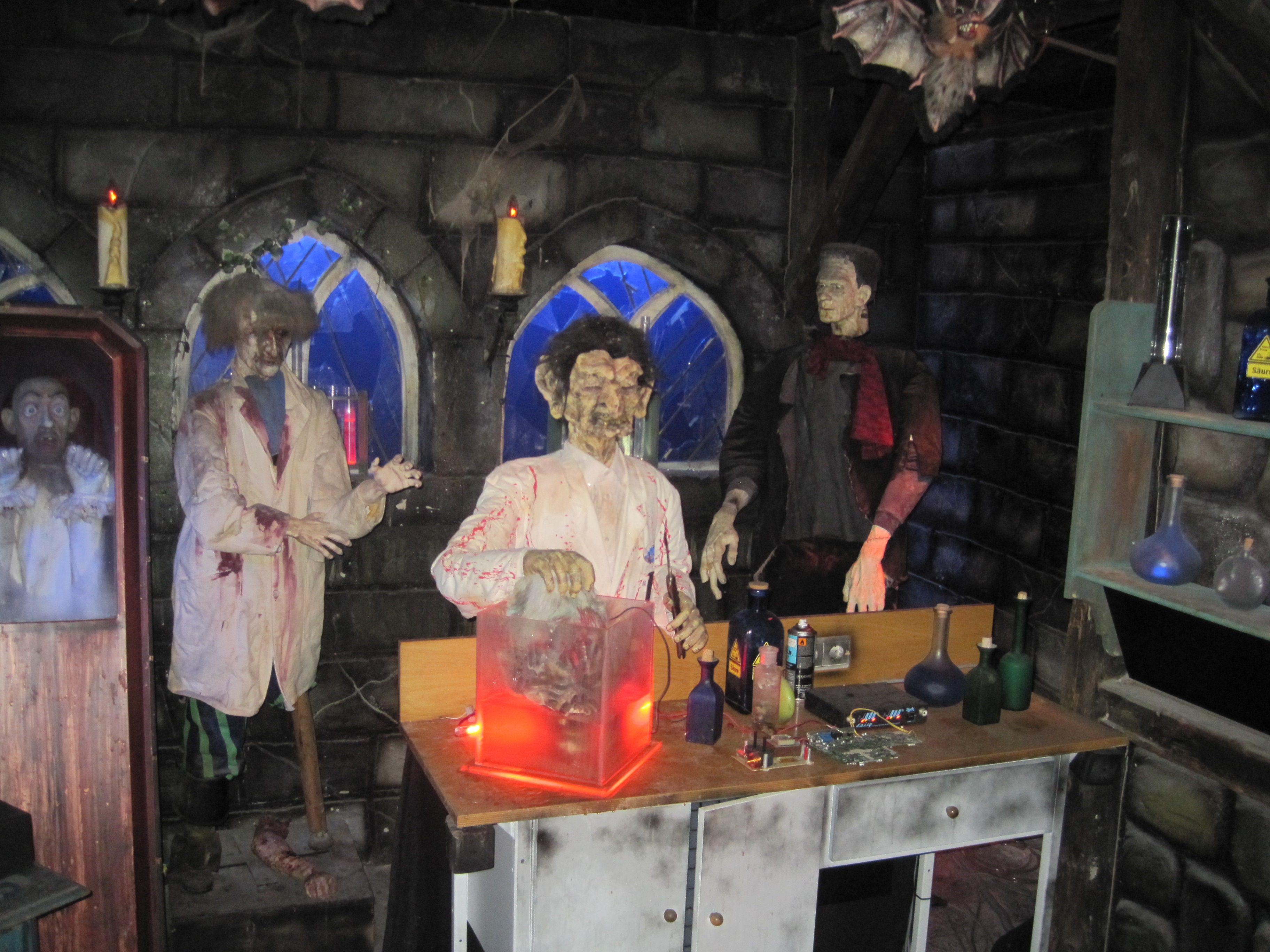
Geisterschloss — Europa-Park, Italian themed area. Image: Olivier Bruchez / Wikimedia Commons
Geisterschloss boarding sequence
The queue for Geisterschloss approaches the loading area through the haunted castle facade, which is a multi-storey building with Gothic and Italian Renaissance architectural references. The interior approach to the loading platform is enclosed within the ride building, meaning guests experience some of the attraction's environmental theming before they board.
At the loading platform, the vehicles move at a consistent slow pace. Operators typically assist guests by indicating when to step in and by helping young or less mobile guests complete the transition. The vehicles are two-person units facing forward; the seat configuration is simple lap bar and handrail.
The boarding moment is the most operationally sensitive point of the Geisterschloss experience. Guests who have not encountered a moving-vehicle boarding system before sometimes hesitate, which requires operator assistance and can briefly interrupt the chain rhythm. Parks with high proportions of first-time visitors to this type of system often deploy additional operators at the loading point.
Conventional vehicle boarding: Piccolo Mondo
Piccolo Mondo uses a boat-type vehicle that travels through a water channel. The boarding process is a conventional stop-and-go approach: the boat pulls into the loading dock, stops, guests board from a stationary platform, and the boat departs. The system is operationally simpler from a guest perspective because the vehicle is still during boarding.

Piccolo Mondo interior — Europa-Park. Image: Mw007 / Wikimedia Commons
The boat format means the vehicle sits lower than the platform level, requiring guests to step down into the boat. This creates a different physical movement than stepping horizontally into a conventional dark ride car. The step-down boarding is particularly relevant for guests with limited lower body mobility and for guests carrying young children.
Row seating in the boat is arranged lengthwise — guests sit in a linear formation facing the direction of travel. Capacity per dispatch depends on the number of guests who complete boarding within the docked window. Unlike the Geisterschloss continuous chain, Piccolo Mondo's throughput is batch-limited by the loading and dispatch cycle time.
Structural comparison of the two approaches
The key distinction between the two systems is in how they distribute the operational cost of loading. The continuous chain system distributes the loading challenge to individual guests — each person must successfully board a moving vehicle. The stop-and-go system consolidates the operational pause into a defined batch loading window, after which all loaded vehicles dispatch simultaneously.
Neither approach is universally superior. Continuous chain systems achieve higher theoretical throughput under consistent guest flow conditions. Stop-and-go systems are more predictable for guests and require less precise guest coordination during boarding. Parks with diverse guest demographics — including families with very young children and guests with mobility considerations — tend to benefit from the predictability of stop-and-go systems even at lower throughput.
Theming and interior environment
Both Geisterschloss and Piccolo Mondo are enclosed dark rides, meaning the ride experience takes place inside a building where the environment is fully controlled. Geisterschloss uses a haunted castle theme with Gothic and theatrical elements; Piccolo Mondo takes guests through a series of miniature world scenes.
The interior theming of both attractions is visible from the ride vehicles and structured to provide a consistent viewing angle as the vehicle moves through the scene sequence. In both cases, the vehicle's forward-facing orientation means theming elements are positioned along the travel path rather than surrounding the guest from all sides. This differs from rotating-vehicle dark rides where the viewing angle is designed to change throughout the experience.
What this article does not cover
- The complete interior scene content of either ride.
- Accessibility provisions beyond the boarding system observations noted above.
- Historical changes to either attraction since opening.
- Throughput or capacity data — these are operational figures that change and are outside editorial scope.
- Other dark rides at Europa-Park beyond these two examples.

